
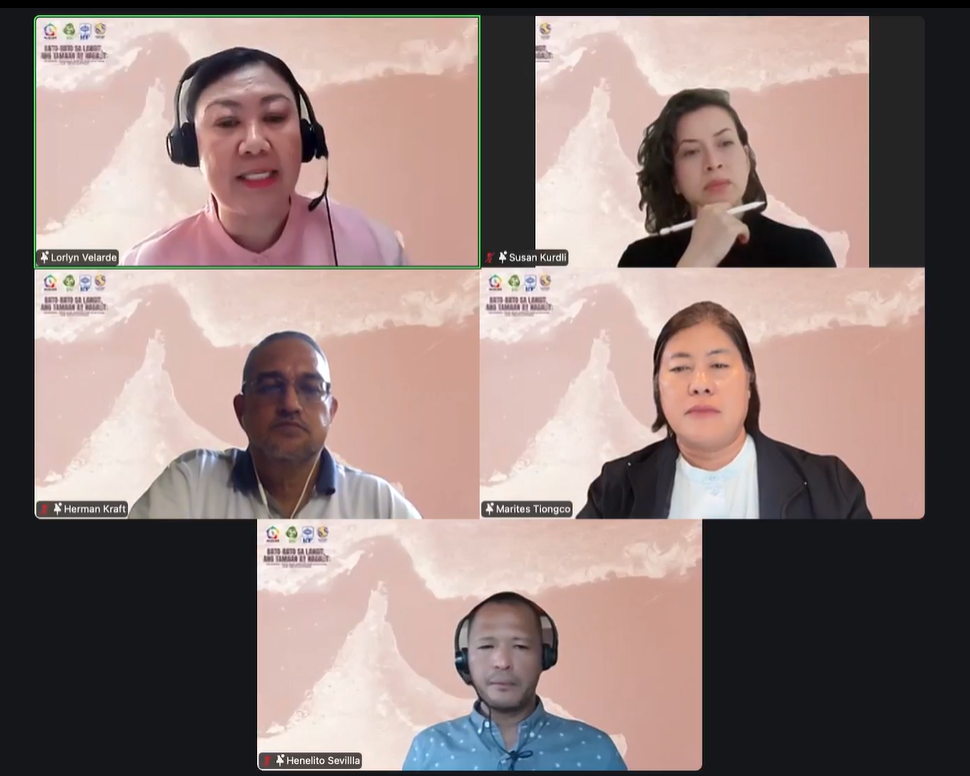
As tensions in the Middle East continue to raise concerns over global oil supply, economic stability, and regional security, the Philippine Academic Society for Climate and Disaster Resilience (PASCDR), UP Resilience Institute (UPRI), Kapisanan ng mga Brodkaster ng Pilipinas (KBP), and Philippine Social Science Council (PSSC), conducted the webinar “Bato-bato sa Langit, ang Tamaan ay Nagalit: US/Israel-Iran Conflict and its Implications for the Philippines” on April 22, 2026. The webinar convened experts in international relations, political science, economics, media, and resilience studies to discuss how ongoing developments in the Middle East may affect Filipino communities.
The discussions emphasized that although the conflict is geographically distant from the Philippines, its impacts are already being felt locally through rising fuel prices, economic uncertainty, disruptions in global trade, and increasing household expenses. Speakers highlighted how conflicts abroad can quickly affect interconnected economies and supply chains, influencing transportation costs, food prices, energy systems, and the broader cost of living for Filipinos.
Providing historical and geopolitical context to the conflict, Dr. Henelito A. Sevilla Jr. of the UP Asian Center discussed the strategic interests and motivations of the United States, Israel, and Iran, framing the issue as a “war of choice or necessity.” Meanwhile, Prof. Susan Kurdli of De La Salle University explored Iran’s foreign policy, political institutions, and history of regional tensions, encouraging participants to look beyond simplified narratives and social media headlines in understanding the complexities surrounding the conflict.
Relating the issue to the Philippine context, Prof. Herman Kraft of the University of the Philippines Diliman explained the importance of the Strait of Hormuz, a major global oil shipping route where a significant portion of the world’s oil supply passes. He noted that disruptions in maritime trade and oil transport may contribute to higher gasoline prices, transportation costs, inflation, and rising prices of basic goods and services in countries like the Philippines that rely heavily on imported fuel.
Dr. Marites Tiongco of De La Salle University further discussed the broader economic consequences of prolonged geopolitical tensions, particularly in terms of the possible increase in food, electricity, transportation, and logistics costs. The discussions also highlighted the human dimension of the conflict, including its potential effects on overseas Filipino workers (OFWs), seafarers, stranded travelers, and Filipino families dependent on overseas employment.
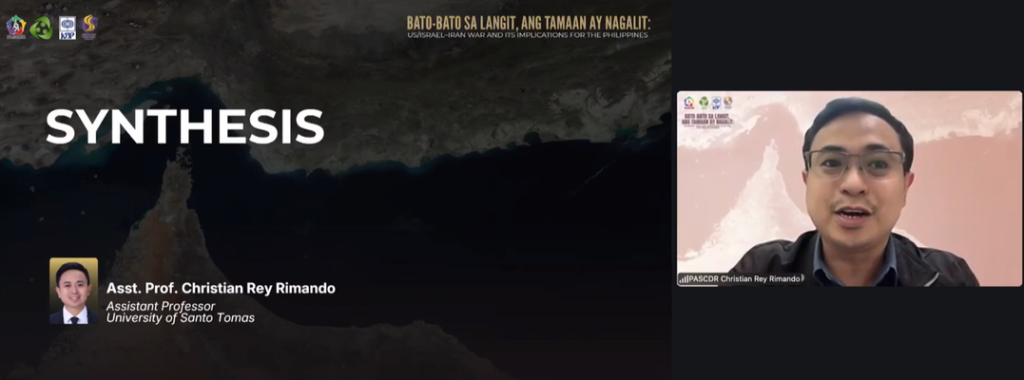
Prof. Christian Rey Rimando of the University of Santo Tomas and member of the PASCDR Board of Trustees synthesized the discussions by emphasizing how modern global conflicts, though geographically distant, can still produce immediate consequences for Filipino households, livelihoods, and national economic stability. He highlighted the country’s vulnerability to disruptions in global oil supply, maritime trade, and rising commodity prices, as well as the human impacts of the conflict on overseas Filipino workers (OFWs), seafarers, stranded travelers, and Filipino families dependent on overseas employment. Prof. Rimando also noted the importance of critically evaluating information online amid the rapid spread of misinformation and disinformation during times of geopolitical conflict.
By bringing together experts from different fields, PASCDR, UPRI, KBP, and PSSC aimed to highlight the importance of interdisciplinary and evidence-based discussions in helping the public better understand emerging global risks and their implications for the Philippines. The webinar ultimately underscored the need for informed citizenship, critical engagement with local and international news, and continued public dialogue in strengthening societal resilience amid an increasingly interconnected and uncertain global environment.
Full recording of the webinar may be accessed here: https://www.facebook.com/share/v/18RkyLPaJ3/
[Cross posted at UP Resilience Institute website]